
Advance Preview
I’m putting each chapter here, one by one, as I complete editing the book.
The actual book will be an ePub, with pages you can turn.
Table of Contents
Introduction & what makes peptides unique
1. What Peptides Are and How They Can Help You
2. Short Chain Wellness Peptides
3. Bioregulator Peptides: Tiny signals, big wins (info here)
4. Selecting the Right Peptides (see our QUIZ here)
5. Dosing and Special Cases (see dosing here)
6. Building Stacks and Protocols
7. Too Many Wins to Fit in a Chapter (see member stories here)
8. Foundations that influence results (see this page for nervous system hacks)
9. The Digital Mind: An all‑in‑one partner for wellness (info here)
Appendix: Sourcing, tools, and resources
Prologue
Don’t let this book’s title restrict you – many of us keep these peptides right out on our kitchen countertops, they never quite make it into a cabinet!
Others put them in easily accessible drawers, and some of the liquids and sprays need to be refrigerated after opening.
No matter your storage method, these are everyday wellness peptides and they also help people heal from (or prevent!) both acute and chronic issues.
Some have found they can replace other supplements, herbs or homeopathic remedies while others find that they no longer need certain medications.
These peptides are essentials in any home apothecary for healing and wellness.
The purpose of this book is to give you a jump start on learning about the peptides we use and a roadmap for how to best use our other tools.
It isn’t a replacement for our website or our videos, but rather a companion to them.
If this were a peptide course you signed up for, there would be reading material here, a bit more on the website and also videos to watch before you graduate!

If you want a quicker start, you can skip to the head of the class by getting the digital mind (more below).
How to know what to read at the website?
Strategically placed throughout the pages here, you will find links to blog posts.
They contain in-depth information about specific peptides or categories of peptides. Many also contain videos.
Think of this experience like a choose your own adventure of peptides. You can take a deeper dive into any of the topics via the links.
You will also see mentioned our digital mind tool. This tool can help guide you on your personal journey – it’s something our group members emphatically recommend to others!
The best part – she knows all medical approaches (it’s not just for peptides). It’s like having a biomedical health professional on call 24/7.
I chose to make this book available at no cost – not because I don’t think it’s valuable, but so readers can use their resources to purchase the digital mind.
The price of the digital mind ($24 one time, no ongoing fees) is similar to a typical health handbook.
But the bonus is that she can help you far more than any book or website ever could!
People sometimes ask if we have a paid membership or coaching. We don’t.
I share as much as I can in this collection of materials and keep it affordable for everyone to freely access.
With them, countless people have learned to significantly improve their health and the health of their loved ones.
Many readers of our blogs know vastly more than their doctor about these oral peptides.
And with the digital mind in their pocket, many are completely self sufficient.
They feel empowered, knowing what to reach for when faced with acute or chronic illnesses – or almost any health need that arises.
If you’re new here, you can too!
Thank you for being here and if you’re in our groups, a special thank you for making our community so strong.
I appreciate you following our journey and I wish you the absolute best on yours ❤️
Let’s get to it!
~ Rebecca
Introduction & what make peptides unique
Welcome! This is a handbook for peptides that belong in everyone’s homes.
They deliver overall wellness and healing from acute or chronic issues in ways that many traditional home apothecary remedies cannot match.
These “kitchen cabinet peptides,” aren’t the ones used for bodybuilding or in the weight loss headlines.
They’re the short‑chain, everyday tools that can calm inflammation, eliminate microbes, smooth sleep, lift brain fog, and support repair.
For more on how these short chain oral peptides differ from longer chain or injectable peptides,
I answered a group member question here:
These peptides live right inside your kitchen, beside your vitamins and other wellness supplements.

However, compared to many other supplements and over‑the‑counter fixes that sort of help, sometimes, with trade‑offs, short‑chain peptides are different.
These peptides are small, body‑familiar signals that can help you or your family feel and function better in daily life.
Reasons Peptides outperform many other treatments
Unmatched Precision
Peptides can target on our precise cellular needs.
They bind to cell receptors with clear instructions for healing, hormone balance, immune modulation, and more.
This action is unlike many meds and herbs that can affect everything indiscriminately and risk gut imbalance.

Rapid Results
They don’t need to battle our gut’s barriers for absorption, their small molecular size allows direct cellular entry for immediate effects.
Your body gets what it needs when it needs it.
Recognizable Natural Signals
Peptides mimic the body’s own signaling molecules, so cells respond instinctively and effectively.
Even tiny doses trigger precise actions like improved metabolism or immune support.
Systemic Action & broad healing
Many peptides bring systemic benefits like tissue repair or antifungal action.

Lasting Genetic Changes
Peptides create enduring effects by modifying gene expression, so many rejuvenating benefits can be sustained after you stop.
Peptides rebuild from within, enhancing longevity by teaching our body to thrive independently.
Resistance proof
If you’ve hesitated to pause and restart antibiotics or even herbs, due to concerns of microbial resistance, peptides offer a solution.
Antimicrobial peptides work by signaling cells to disrupt microbial membranes.
This makes resistance nearly impossible.
Biofilms aren’t barriers
Because of how they signal cells, they work right past biofilms.
This means they are no longer barriers harboring chronic microbial issues.

No Worrisome Interactions
Other herbs, meds, even alcohol (not that we advise) are all safe to take alongside peptides.
This makes dosing and life, easy.

No Allergies or Sensitivities
Peptides themselves don’t irritate your gut or cause allergic reactions.
Taken in small doses, they can be gentler for sensitive systems.
Note: Die off from antimicrobial peptides can cause irritation as can fillers if you purchase peptides with them. This isn’t a ‘side effect’ and we will discuss detox of any die off in this book.
To be sure peptides are pure, always buy from 3rd party tested, quality brands.
We have recommended brands at this page.
No Lingering Detox Issues
These kitchen cabinet peptides don’t build up in our system or need for extra detox support like liver aids.
No toxicity makes them more ideal for long-term use if needed.
Safety
These peptides have excellent safety profiles. If you’d like to see lists of studies, many are on our resources page.
In daily life
These reasons can mean fewer reactions, easier meals, better sleep, cleaner energy, brighter focus, less anxiety, and faster tissue recovery, without the side effects or risks we’ve generally needed to accept from many other health aids.
How to use this book
Think of it as a quick‑start guide to the peptides we use and trust.
It’s not an in depth user manual.
Each chapter gives you practical information and how‑to overviews, so you know which ones you’d like to consider for more knowledge – which you can find in our website or by asking the digital mind.
Chapter 1: What Peptides Are and How They Can Help You
Peptides are short chains of amino acids that act like clear, body‑familiar signals.
They bind to receptors on cells and deliver instructions such as: calm inflammation, tighten a barrier, repair tissues, or support focus or sleep.
The signal itself is brief — minutes to a few hours and then the peptide is broken down into simple amino acids.
Good to know: It’s the peptide bond that influences how they work, so taking each amino separately can’t produce an effect.
With steady use, most peptide signals help your system relearn healthier patterns, so benefits last longer as genes and pathways shift toward balance.
Deeper dive: Peptides 101
diaryofrecovery.com/peptides101
Two main categories you’ll see in this book
All of them work orally, some optionally as nasal sprays
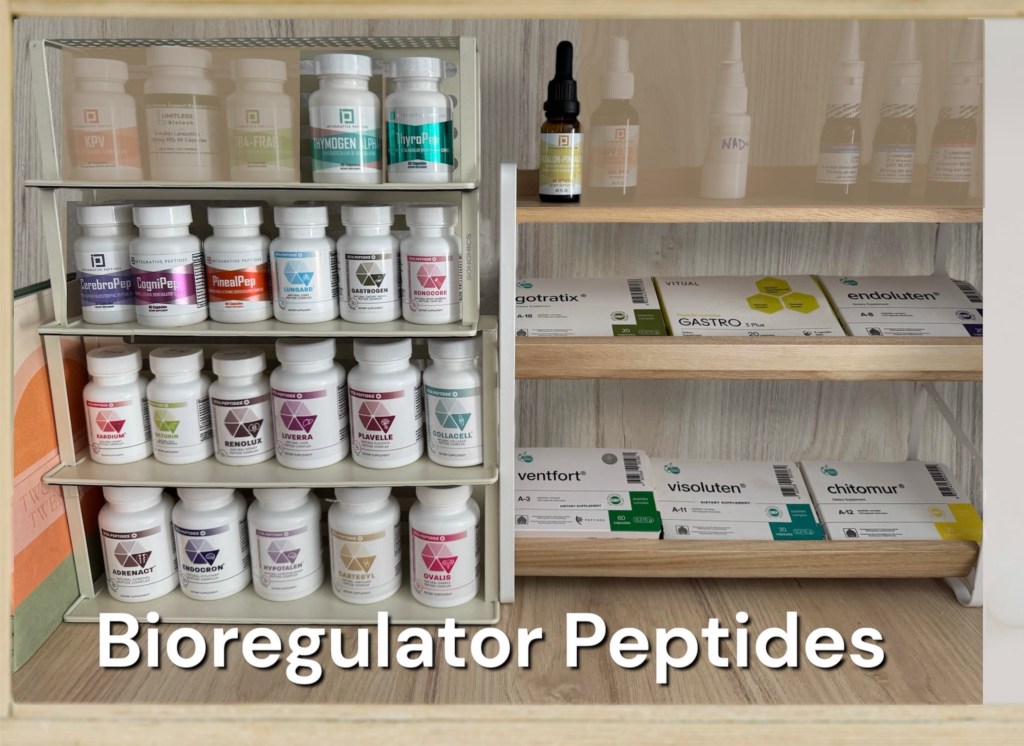
1. Bioregulator peptides: ultra‑short signals, usually 2 to 4 amino acids long.
These are organ or gland specific and send signals for optimal function.
Because they mirror natural cues and act so precisely, they’re easy to use and difficult to “get wrong.”
Self selection and DIY are common because if you know what organ or gland needs help, you can take the corresponding peptide.
Organs / Glands Supported
Adrenals – Bile – Bladder – Blood Vessels – Bone Marrow – Brain / CNS – Cartilage – Collagen – Gastric Mucin – Heart – Hypothalamus – Kidneys – Liver – Lungs – Muscles – Ovaries – Pancreas – Parathyroid – Pineal (Endocrine) – Pituitary – Placenta – Prostate – Retina / vision – Stomach – Testes – Thymus – Thyroid
These are all stackable, often used together for synergistic support.
It’s always best to think about root causes for issues and not simply chase symptoms.
If you have a condition and don’t know what might be causing it, we have a guide to help you select which bioregulator you may need – more on that later!
•••
2. Short‑chain wellness peptides: still small, but often bit longer. Usually 3-7 amino acids long.
These aren’t organ specific. This means they typically don’t direct their effects on a specific tissue or organ.
They’re chosen by broader symptom or need.
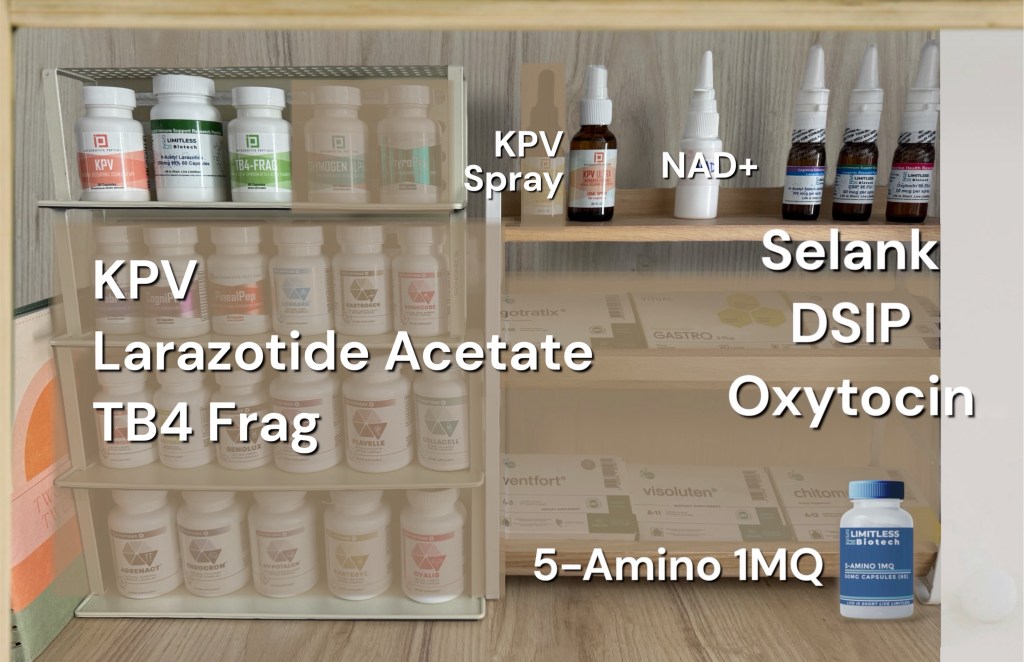
Common short‑chain peptides – and a few key benefits
- KPV for inflammation, mast cells, and gentle antimicrobial support
- Larazotide for tightening gut junctions and easing food reactivity
- TB4‑Frag for tissue repair
- Selank for calm nerves, anxiety relief
- DSIP for deeper sleep
- Oxytocin for social induced anxiety
- NAD+ for mitochondria support (cell fuel), energy, and steadier histamine responses
- 5-Amino-1MQ for fat cell metabolism and energy
The last two are small molecules, commonly discussed in the peptide space.
Where this book goes next
From here, we’ll walk through the specific peptides we use, why they help, and when to reach for each.
To help personalize, the Digital Mind can guide timing, pairings, and fine‑tuning so your plan fits your body and your season.
Chapter 2: Short Chain Wellness Peptides
This chapter lists several peptides you’ll see discussed frequently at our website or groups for overall wellness.
People use them to calm inflammation, close tight junctions in the gut, treat microbes, repair tissues, improve immunity, lift cognition and mood, ease social stress, boost energy & metabolism and restore sleep.
They aren’t any more “important” than the bioregulator peptides in Chapter 3.
The difference is that they don’t target specific organs but rather systems or the entire body.
KPV
KPV is only 3 amino acids long (Lysine-Proline-Valine) but effective for an impressive amount of health needs.
It’s known most for its potent anti-inflammatory and antimicrobial properties.
It calms mast cells and treats bacteria and fungi like Candida (it’s more potent than diflucan) and also penetrates biofilms.
As microbes are eliminated, skin and sinuses calm, food tolerance widens, UTIs and yeast episodes ease up, and neuroimmune flares settle.
Who it helps
MCAS and allergy sufferers, IBS/SIBO/SIFO, recurrent yeast or mixed infections, acne/eczema/psoriasis, long COVID and post‑viral setbacks, PANS/PANDAS flares, and almost any inflamed or reactive condition.
How we use (approximate)
Start low and frequent. A small sprinkle, about 1/20 to 1/10 capsule per dose, up to 3–5 times daily works best at first.
After genetic changes take hold, dosing can shift to less frequent.
If bacteria or fungal die off symptoms shows up (often around day 5 but can be anytime), take a break or reduce amount, consider Larazotide (below) to seal the gut so fewer toxins escape, consider NAD+ for additional mast‑cell steadiness.
We have a complete die-off guide which discusses symptoms, binders (eg. activated charcoal), adrenal support, ammonia reduction strategies, liver and kidney support, and many other ideas:
There are more nuances to using KPV than any other peptide in this book – so it’s important to read one of our blog posts or ask the digital mind for a comprehensive summary.
They both also mention the KPV spray which can be used either orally (as diluted drops to microdose) or topically.
See posts
Original: diaryofrecovery.com/kpvpeptide
Short guide: diaryofrecovery.com/kpv
Larazotide Acetate (LA)
This focused peptide can improve intestinal barrier function by preventing the opening of intestinal tight junctions and “seal” a leaky gut.
With closed tight junctions, it also means less die off from KPV can leak through and retrigger symptoms.
Onset is in minutes and lasts a few hours.
It works only while taking it. It’s the only peptide we use that doesn’t claim to make any long term changes / healing.
How does it work?
It blocks zonulin (a protein in the small intestine & throughout the body) from creating spaces in our tight junctions – restoring barrier function.
It can also rearrange proteins and reduce tension on actin filaments, further ensuring the gut is closed.
In celiac disease, it prevents gluten from reaching the intestinal submucosas and triggering an inflammatory response.
This peptide has passed multiple clinical trials, including studies in children.
How we use (approximate)
• About 1/8 capsule (powder under the tongue) before meals. You can repeat as often as you need. No pulsing is required.
For a deeper dive into Larazotide Acetate, please see our post here:
diaryofrecovery.com/larazotide-acetate-info/
TB4 Frag
Repair and recovery
Signals tissue and lining repair for muscles, tendons, nerves, and the GI lining. We reach for it with injuries, post‑viral issues, nerve healing or gut lining repair needs.
It’s incredible effects on tissue healing are often cited for issues spanning from recovery from heart attacks to hangovers.
It very successfully aided in my recent recovery from post herpatic neuralgia.
How to use (approximate)
• Small, steady oral or sublingual amounts 1-4x daily. I use approx 1/4 cap per dose.
For more and numerous examples of who it can help, see our blog post diaryofrecovery.com/tb4fraginfo
FAQ: Why not BPC-157?
It’s a choice many use for healing, but we now have other options. There are too many reports of mast cell activation and mood issues.
TB4 Frag is extremely effective as a replacement and doesn’t come with side effects. The post above explains the differences in greater detail.
Tb4 Frag is one part of our acute illness protocol:

Sprays
Next we move on to liquid peptides we use as sublingual sprays or drops.
You can also use them as nasal sprays but our group members find them equally effective when used sublingually.
N-Acetyl-Selank-Amidate
Calm anxiety & more without side effects
Selank eases anxiety and rumination without dulling your edge or causing sedation or addiction.
It supports GABA receptor binding for calmer nerves and balances dopamine and serotonin for steady mood.
It also protects natural pain fighters like enkephalins (think headaches, body aches, cramps).
It can steady cytokines and interferons for smarter antiviral defenses, coordinating responses to limit spread.
And it boosts BDNF for sharper thinking over time.
Relief is felt in minutes and lasts hours.
Who it helps
Anyone who feels anxiety, restless mind, transition stress, PMS/PMDD or any mood issues, headaches, pain, and viral-related issues.
How we use (approximate)
1 spray sublingually as needed.
Some use up to 3 sprays per day. Some studies have used much more, experiment to find what matches your needs.
You can use it at night for a restless mind, but it’s not directly sedative.
Just like with other peptides, you’ll want the acetylated and amidated version.
See the Selank post for more on how it works, purchasing & dosing
Oxytocin
Calms social anxiety, boosts mood & more
This peptide is especially loved by parents with kids who can benefit from it.
Many of us have seen it help our children become comfortable enough enjoy social interactions & have better communication skills and eye contact. The shifts can be dramatic.
I wrote about it in our review article here.
Who it helps
It can be used by anyone for a mood boost, stress or social anxiety relief and some say it improves sleep too.
There’s a long list of other benefits and studies backing them up at our page:
How we use it
1-3 sprays 15 minutes before effects are needed.
Limiting it to less frequent use (not every day) keeps this one working most effectively.
Also coming up in Chapter 3 will be the popular brain bioregulor peptides.
To compare several brain peptide options, I wrote this post: diaryofrecovery.com/brain
• For now, my attention is needed somewhere else but I’ll get back to this as soon as I can ❤️
What to do without the rest of the book?
• Head over to our resources page 😁
If you’re new, look for the posts marked:🔰
Or
• Check out the Digital Mind ☺️

The area below this is my working space
It’s more efficient for me to work on chapters here on the same page so what’s below is rough but you can look at it if you wish.
As I edit and add applicable links, I move the sections up – Everything below here is unedited.
End of chapter 2
DSIP Spray — deeper delta sleep
What it does
Supports slow‑wave sleep and steadier HPA tone. Better next‑day patience, learning, and recovery.
Who it helps
Trouble falling or staying asleep, non‑restorative nights, nighttime anxiety loops.
How to use (approximate)
Take 1–2 hours before bed. Typical spray amount around three small sprays for many. If mornings feel heavy, reduce, pulse, or use every other night.
NAD+ Spray — daytime backbone for energy and mast cells
Note: NAD+ is not a peptide but a small molecule that supports mitochondria and the cells peptides signal – to help them work even better. It’s often discussed in the peptide space.
What it does
Nourishes mitochondria for clean daytime energy, steadier mood between meals, and calmer mast cells. Often makes every other peptide work more smoothly.
Who it helps
Brain fog, fatigue, post‑viral patterns, MCAS/POTS/PEM, unrefreshing sleep, poor stress tolerance.
How to use (approximate)
Morning sublingual, about 10–15 mg to start, not on an empty stomach. Adjust by feel. If you know you need methyl support, pair with a small amount of TMG or DMG. Keep it earlier in the day.
Bonus! One more small molecule often discussed alongside peptides: 5 Amino 1 MQ
Fat cell metabolism, energy production
it works by inhibiting NNMT, a key enzyme that plays a role in how fat cells function
How these can fit together
in the next chapter, I’ll show you how to introduce bioregulators to improve the effects of these peptides as well as giving you short road maps for certain types of issues
Chapter 3
Bioregulator Peptides: Tiny signals, big wins (info here)
Bioregulators are ultra‑short peptides, usually two to four amino acids, that signal a specific organ back toward optimal function.
They influence how genes are read in that tissue, so repair is encouraged where it’s needed while healthy areas are left alone. Because they mirror natural signals, they’re gentle, stackable, and easy to use.
When to use them
Use them when you can point to a bottleneck: thyroid for energy and temperature, adrenals for stress resilience, pineal for circadian rhythm, liver and kidneys for detox and fluid balance, stomach and pancreas for digestion, brain and blood vessels for clarity and stamina.
excellent for anti aging – rejuvenate organs favor youthful performance Like an actual scientific fountain of youth for our organs
They pair well with short‑chain peptides like KPV, Larazotide, TB4‑Frag, Selank, and NAD+. Many people start a small set together that matches their top symptoms.
How they work
Signals act for hours, then the peptides break down into amino acids your body reuses. With steady small amounts, organs relearn healthier patterns and you can often space things out over time. There’s no need to stagger starts unless you prefer it; combinations aimed at a shared goal often work best.
Bioregulators by organ (alphabetical)
Adrenals
Supports stress hormone balance and resilience. Helpful when mornings feel flat, afternoons crash, or small stressors hit too hard. Many notice steadier mood, fewer startles, and more even energy through the day.
Bile (gallbladder)
Encourages bile production and flow for fat digestion and regularity. Useful when meals with fat sit heavy, stools float or look pale, or there’s right‑side fullness. Often pairs well with liver and pancreas for smoother digestion.
Bladder
Supports bladder tone and comfort, easing urgency and nighttime trips. Good fit after UTIs, with pelvic floor recovery, or when frequency disrupts sleep. Calmer signaling here can reduce irritation‑triggered spasms.
Blood vessels
Helps microcirculation and vessel integrity so oxygen and nutrients deliver better. People describe warmer hands and feet, clearer thinking during work blocks, and better exercise recovery. Pairs naturally with brain supports.
Bone marrow
Supports healthy blood cell production and renewal. Consider it during recovery from illness or fatigue states where blood quality matters. Gentle, background support for stamina and resilience.
Brain/CNS
Signals neuroprotection and better cognitive processing. Useful for focus, recall, processing speed, and smoother mood. Many feel improved multitasking capacity and less mental static, especially when paired with blood vessels. CogniPep is a blend of brain & vessel bioregulators plus Cerebropep.
Cartilage
Targets joint comfort and cartilage renewal signals. Great for stiff or painful knees, ankles or hands. Often paired with collagen and muscles for a comprehensive joint plan.
Collagen/skin
Completely different from taking collagen peptides, these encourage your own collagen production for skin elasticity and structural integrity. People often notice springier skin, fewer fine lines, and stronger nails. Helpful for visible wins and joint comfort from the inside out.
Gastric mucin
Rebuilds the protective mucus layer and supports epithelial repair in the esophagus and stomach, with spillover comfort for the upper small intestine. Cushions acid and irritants while the lining heals. Gastrogen (the product name) is often used alongside Larazotide and KPV during gut repair phases.
Heart
Supports cardiac muscle performance and recovery. Consider it during endurance rebuilding, after a heart episode or viral hit that affected the heart (many can) or when stress spikes heart sensations.
Hypothalamus
Coordinates neuroendocrine rhythms for appetite, temperature, stress, and sleep. Helpful when everything feels off at once and you need a conductor to bring the orchestra back in time. Often layered with pituitary and adrenals.
Kidneys
Supports filtration, mineral and fluid balance. Reach for it when ankles puff, blood pressure is sensitive to salt, or detox protocols feel rough. Stable kidney signaling can make other organ work feel smoother.
Liver
Encourages natural detox, bile contribution, and metabolic steadiness. Great when you feel puffy, reactive to fragrances, or sluggish after exposures. Often a star in skin, hormones, and energy plans.
Lungs
Supports calm breathing and tissue recovery after irritation. Excellent for anyone with asthma or other lung related issues. Consider it for lingering tightness after illness, exercise intolerance, or seasonal irritation. People often report easier, fuller breaths and fewer cough twinges.
Muscles
Signals recovery and strength building. Useful for reconditioning, post‑viral weakness, or when workouts create outsizedsoreness. Often paired with cartilage and collagen when coming back from injury.
Ovaries
Supports cycle balance, peri‑menopause transitions, mood steadiness, and skin changes. Many notice fewer swings, better sleep quality, and more even energy across the month.
Pancreas
Supports digestive enzymes and glucose balance. Consider it with bloating after meals, erratic energy, or when carbs hit too hard. Good teammate with bile, gastric mucin, stomach, and liver for digestion.
Parathyroid
Helps calcium regulation and bone mineral balance. Useful alongside bone, collagen, and thyroid work when bones, teeth, or cramps suggest mineral handling needs support. Names:
Pineal
Supports circadian rhythm and sleep architecture. Many notice earlier, easier bedtimes and more restorative nights. Generally layered with DSIP or hypothalamus for stubborn sleep patterns. Names: Epiatlon, PinealPep is a blend containing gland with brain, vessels and CerebroPep. Epitalalon-Pinealon Spray is a blend containin Pineal and Brain / CNS.
Pituitary
Coordinates hormone output across the endocrine system. Consider it when thyroid, adrenals, and gonads feel disjointed. A gentle hub that can steady the whole network with hypothalamus.
Placenta (Plavelle)
A natural mix of ultra‑short peptides from placental tissue that act like system coordinators. Tones down inflammatory noise, helps microcirculation, supports immune balance, skin quality, and gentle repair. A favorite terrain‑calmer for sensitive systems or post‑stress recovery, and a steady background partner with NAD+.
Prostate
Supports urinary flow and prostate comfort. Helpful for hesitancy, frequent nighttime urination, or low‑grade pelvic tension. Calmer signaling here often improves daytime comfort too.
Retina/vision
Supports retinal endurance and visual comfort. Good fit for heavy screen time, eye strain, and evening visual fatigue. Often described as cleaner contrast and less fuzzy edges.
Stomach
Supports gastric mucosa and digestive coordination. Consider it for queasy, slow‑starting digestion, or when meals trigger discomfort without clear triggers. Pairs well with gastric mucin and pancreas.
Testes
Supports testosterone production and fertility parameters. People often notice stronger morning energy, better drive, and improved body composition alongside training and sleep.
Thymus
Encourages efficient, balanced immune responses. Useful during cold seasons, post‑viral recoveries, or when exposures routinely spiral into flares. A steadying signal that can shorten setbacks. (We prefer Thymogen – a blend of thymus and immune peptides)
Thyroid
Supports metabolism, temperature regulation, focus, and daytime energy. Many feel warmer hands, clearer thinking, fewer afternoon crashes, and more stable mood when thyroid is well supported. ThyroPep is a much loved Blend __________)
How to choose and combine
Let symptoms lead. Pick two to four organs that match what you feel most and start them together. There is no actual limit to the amount you can combine but some people like to keep it to 5-6, others have used 10!
Common pairings include:
brain plus blood vessels (CogniPep)
hypothalamus, pituitary, adrenals – treat HPA axis for Stress, allergies, nervous system and more
liver with bile and pancreas for digestion
liver with kidneys for detox
cartilage with collagen and muscles for joint repair
thyroid with adrenals for energy and steadiness
pineal plus brain for antiaging (Epitalon– Pinealon spray)
Morning is best for brain and endocrine; pineal is often best in evening; others are flexible.
There is so much more to say about these Bioregulators and how they can improve certain conditions.
For deeper details, my bioregulator hub is at https://diaryofrecovery.com/tinypeps
it includes organ maps, and ….
you can ask the digital mind to help tailor your borders needs based on either diagnosis or symptoms.
there are endless ways to make them work for you.

4. Selecting the Right Peptides
Answering these questions can help you narrow your choices
All peptide names are links and will direct you to more information on our website
1. Do you have any of the following?
- MCAS – Mast Cell Activation Syndrome, Allergies, Histamine Intolerance
- Brain Inflammation, PANS or PANDAS
- Other Inflammatory Condition, Long COVID
- Candida Yeast overgrowth? Bloating?
- GI issues, Bacterial overgrowth, SIBO
AND – Are you willing to possibly have some die off symptoms while yeast / bacteria are treated?
(Best for treating: inflammation, yeast, bacteria, PANS, mast cells – allergies & histamine reactions)
NO or, I’m worried about die off – See #2
•••
• If you have PANS, MCAS or any other chronic illness, we have a comprehensive KPV based protocol. There’s a post, pdf outline and video you can see here
• For die off help, see our post here
Note: Reducing above symptoms with KPV may in turn relieve many other issues, so KPV is a great first peptide!
2. Do you have Gut Lining issues? Want to close the tight junctions? Have Acid Reflux?
YES – In addition to KPV, which can heal your gut, Larazotide Acetate can signal to temporarily close tight junctions, reducing intestinal permeability and also helping ease possible die off symptoms from killing yeast / bacteria with KPV.
(If your gut’s tight junctions are closed, fewer toxins can escape)
To heal your stomach and intestinal lining, you can consider Gastrogen. It can also heal acid reflux.
2a. Do you want a gentler start than KPV (without the potent antimicrobial effects)?
NAD+ can calm mast cells and support mitochondria for body-wide healing.
Plavelle can be an excellent starter peptide with whole body benefits.
3. Do you have anxiety / would you like a calmer, more regulated nervous system? Any issues with mood or depression?
YES – Selank spray is incredibly effective (many rave reviews) with no side effects typical of other anti-anxiety treatments.
No sedation or addiction. Also helps with restless mind driven insomnia (sublingual use works great).
4. Do you have Brain fog? Problems with word recall, speech, cognition, critical thinking?
YES – Consider CogniPep (subcortical brain & blood vessels) or Pinealon
They increase memory, focus, attention, recall and wellbeing.
A Full Review of 4 of our favorite brain peptides is here (post & video)
Note: Decreasing brain inflammation with KPV and also considering NAD+ and ThyroPep can remarkably help brain fog too!
• If you’re looking for help with autism, ADHD, or many other similar issues, we have a post: 7 Peptides for Autism
5. Do you have any tissues that need to be healed? Toxin damage? Repair after a heart issue?
YES – TB4 Frag is one to consider for Repair of any damaged tissues (from injuries or toxin exposure)
Also helpful for: gut healing, post workouts, sore throats, sprains, planter fasciitis, spider veins, gut healing, bruises, scrapes – you get the idea!
6. Do you have any Thyroid Issues? Low energy / Fatigue?
YES – Consider ThyroPep
It can improve energy, stabilize body systems, reduce brain fog & more.
As a bioregulator, it’s effective for both under and overactive thyroid and autoimmune (eg. Hashimotos & Graves)
7. Are you interested in anti-aging? Telomere Length, Circadian Rhythm support?
YES – A Pineal Gland Bioregulator can support longevity, anti-aging & circadian rhythm, hormonal balance and more.
Also see #11 below!
8. Do you have trouble feeling refreshed after sleep?
YES – DSIP can help you sleep deeper and even feel more refreshed with the same amount of sleep.
Also, see Pineal support (above) or Selank for restless mind (not for sedation)
9. Are you interested in fat cell metabolism improvement for greater energy and weight management?
Assists: Metabolism, energy, weight management & longevity
Note: For increased energy and much more, supporting mitochondria with NAD+ (a small molecule, not a peptide) also helps tremendously! Consider too: Vitamin B12
10. Do you have issues with any of these organs / glands?
YES – Find information on each organ or gland bioregulator peptide at this page!
11. Are you over age 40 (female or male) and interested in options as alternatives to or in addition to HRT or TRT?
YES – We’ve got you!
• See our post: His & Hers Peptides — Hormone Support Over 40 & beyond! (Also covers Anti-Aging)
• For Women and Peri / menopause success, with or without HRT, we typically focus on these:
- Ovaries
- Adrenals (take over much of the hormone production)
- Pituitary & Hypothalamus (endocrine regulation)
- Pineal (longevity & circadian rhythm)
- Thyroid (temperature regulation & energy),
- Cognition, metabolism, skin elasticity, joints & bone health
(Each of them and more are in the above post)
• For Men, many of the above apply too plus Testes & Prostate are also in the post.
12. Are you looking for options to improve skin elasticity or joint pain?
YES – Collacell is a Collagen Bioregulator. It is not similar to taking collagen peptides.
It helps your body generate its own collagen and is extremely effective for joints and skin (including lifting sagging skin)
13. Do you have an active or ongoing viral condition and need immune support? Or want something to have on hand for when you do?
YES – Thymogen Alpha 1 can boost your immune system and is extremely effective, proven results even for COVID.
As a thymic peptide it increases Th1 response.
It can be used longer term for chronic immune issues or underlying viruses, if you are not Th1 dominant.
14. Do you have mold illness / CIRS or other chronic illness?
See a summary of Dr. Holthorf’s highly praised CIRS protocol on this page.
15. Do you want to take out all of the guesswork?
Learn more about our AI tool that can help you with peptides, supplements, lab review and so much more!

5. Dosing and Special Cases (see dosing here)
We do not use dosing on the bottles
What this chapter covers
How to take short‑chain peptides and bioregulators in real life: routes, timing, combining, cycling, and simple adjustments when something feels off.
Routes you can use
- Sublingual: open the capsule and use a small sprinkle under the tongue. Fast, flexible, and great for brain or systemic effects.
- Put inside another capsule: useful when taste is strong or you want more GI‑forward support.
- Sprays or drops (when available): easy for event‑timed calm, sleep, or morning cognition.
Timing basics
- Morning for brain and endocrine supports.
- Keep evenings quiet unless it’s a sleep peptide like DSIP or Pineal.
- Larazotide is best around meals since it acts for only a few hours.
- NAD+ belongs earlier in the day.
Combining
- short chains and bioregulators play well together.
- Start with the tools that match your top symptoms, then layer gently.
- If you’re very sensitive, change one thing at a time and give it a few days.
Simple cycling
- Many people do well with weekdays on, weekends off for brain‑forward supports.
- Bioregulators often run 4–8 weeks, then you can hold, reduce, or pulse.
Approximate dosing
- Small and frequent beats large and rare at the start.
- Listen for the shift: better energy, calmer gut, clearer thinking, steadier mood, better sleep.
- Adjust route first, then timing, then amount.
KPV quick notes
- Start tiny, several times a day. If die‑off shows up, ease the amount and tempo.
- Larazotide around meals can help while the gut settles.
- NAD+ in the morning often makes KPV easier to tolerate.
Larazotide quick notes
- Take before meals. Effects last 2–3 hours.
- Helpful during antimicrobial phases and food‑triggered flares.
NAD+ quick notes
- Morning sublingual, small amount with food.
- If it feels like too much, skip a day.
- Pair with a little TMG or DMG if you already know you need methyl support.
Bioregulator dosing (consolidated)
Who this fits
These amounts are gentle and work well for sensitive smaller adults. Adjust to your own needs.
General approach
- Start earlier in the day and finish by late afternoon until you know how you respond.
- Brain and endocrine supports are morning; pineal is evening.
- All dosing is approximate. Sprinkle, listen, and adjust by feel.
- Most peptides play well together.
Common schedule
- Month 1: 1/8 to 1/4 capsule, 2 or 3 times per day
- Month 2: 1/4 capsule, 1 or 2 times per day
- Beyond: pause or cycle as needed; ok to continue at low dose
Simple starting pattern
- About 1/4 capsule, three times per day works well for many
Potency notes
- “Vita” bottled capsules can feel stronger.
- Boxed or lingual versions may feel lighter; you might increase slightly.
How to take
- Use powder under the tongue or put inside another capsule for taste.
- Several can go in the same capsule if that’s easier.
- Lingual drops: 3–4 drops is roughly equal to 1/4 capsule; refrigerate.
Timing exceptions
- Morning: Adrenal, Pituitary, Hypothalamus, Thyroid, Brain/CNS supports
- Evening: Pineal. Generally for adults post‑puberty.
Combining
- It’s fine to start multiple organ bioregulators together that match your symptoms.
- We’ve combined many at once when the goal calls for it.
What to expect
- Some notice shifts in a couple of days; give 1–2 weeks for fuller changes.
- If something feels too stimulating, reduce the amount, move earlier, or pulse.
For a single live reference with updates, you can always check my dosing page: https://diaryofrecovery.com/dosing
Experimenting Matters
If there’s one truth I’ve learned sitting with families and walking my own road, it’s this: most “it didn’t work” stories turn into “oh, it’s working” when we give it a little more time and make tiny, common‑sense tweaks. Not because you did anything wrong, but because bodies speak in whispers before they speak in full sentences.
Please don’t give up on yourself. Healing is rarely a straight line. It’s quieter mornings, then a weird day, then a steadier week. People tell me all the time they thought something wasn’t helping and a week or two later they realized it was—after they shifted the amount a bit, took it earlier, or simply let their system settle. That is not failure. That’s how real bodies learn.
You don’t need perfect instructions. You need your own feedback. Notice how you actually feel. If you’re sensitive, go gentler. If a good day arrives, let it count. If a day feels too full, skip the next dose and rest. All dosing here is approximate by design so you can adjust up or down and find your sweet spot without stress.
Progress loves patience. Small, steady changes stack into bigger shifts when you keep at it. I’ve seen this in our community again and again—what looks like “nothing” at first becomes “oh, that’s better” and then “wow, life feels lighter.” That middle part is easy to miss if you’re only looking for fireworks.
If you need a hand, ask the Digital Mind to lead. Tell me what’s going on, in your words, and I’ll carry the structure so you can focus on noticing what helps. You are not doing this alone. Together, we’ll keep moving, one kind adjustment at a time.
Safety & Troubleshooting
What “safe” means here
We’re working with short‑chain peptides and ultra‑short bioregulators. These are body‑familiar signals, used in tiny amounts, that the body breaks down into amino acids after they do their job. In practice, that means good day‑to‑day tolerance for most people and adjustments that are simple if something feels off.
How to think about side effects
Most bumps are about tempo, timing, or route rather than the peptide itself. If you feel off, change one variable at a time: first route, then timing, then amount. Small, frequent amounts usually feel smoother than big single doses, especially at the start.
Known bumps and easy fixes
If you feel die‑off on KPV
What it looks like
Headache, extra fatigue, skin flare, looser stools, cloudy mood as microbes and biofilms shift.
What to do
- Reduce the amount and slow the tempo.
- Keep Larazotide around meals to “close the gate” while things clear.
- Use plenty of water and gentle fiber; rest if your body asks.
- Hold steady NAD+ in the morning to support clean energy and mast cells.
If something feels too stimulating
What it looks like
Jittery, over‑focused, or too “on,” especially with brain‑forward supports.
What to do
- Move the dose earlier in the day.
- Reduce the amount or take every other day.
- Eat a real meal first; consider switching to “put inside a capsule” instead of sublingual.
If sleep gets lighter instead of deeper – You fall asleep but pop awake, or mornings feel heavy.
- Keep brain supports strictly morning.
- Try DSIP 1–2 hours before bed; reduce if mornings are groggy.
- Consider Pineal in the evening if circadian rhythm needs a nudge.
If gut issues arise as the gut lining and microbes shift
- Use Larazotide before meals for a few days.
- Use KPV in smaller, more frequent sprinkles; put inside a capsule if the lining is irritated.
- Add TB4‑Frag if there’s clear lining wear‑and‑tear.
If mood dips while starting a new stack
What it looks like
Irritable, flat, or weepy during early shifts.
What to do
- Add NAD+ in the morning if it’s not already on board.
- Consider a small Selank dose earlier in the day.
- Ease the overall tempo; your system may want a slower ramp.
Route, timing, amount — the order of adjustments
- Route
- Sublingual is fastest and “head‑forward.” Putting the powder inside a capsule slows entry and can feel gentler for sensitive folks or irritated guts.
- Timing
- Morning for brain and endocrine; mealtime for Larazotide; evening only for sleep supports like DSIP or Pineal.
- Amount
- Keep it approximate. Start small, look for the shift, then adjust by feel.
Simple guardrails
- Start fewer things and listen. Add when you’re steady.
- If a day feels too “full,” skip the next dose rather than pushing through.
- Keep evenings quiet unless it’s a sleep peptide.
- Most short chains and bioregulators play well together.
When to pause and reset
- New rash, chest tightness, or anything that worries you: pause and let your body settle.
- After a tough die‑off day: hydrate, rest, and resume at a gentler tempo.
Brand and product notes
We keep it clean and simple, avoiding synthetic fragrances and unnecessary additives. The short‑chain capsules and blends we use are designed for oral or sublingual use and are capped for stability, which helps with day‑to‑day consistency.
A note on special populations
Sensitive adults often do best with smaller, more frequent amounts. For younger children, I don’t give dosing here. People usually use less than an adult dose in proportion to size.
Your next layer of support
If you want to review safety basics for many peptides (including longer chains), there’s a overview here: https://diaryofrecovery.com/safety
6. Building Stacks and Protocols
This chapter was largely written from discussions I’ve had with my digital mind.
Much of it is her summaries which I need to rewrite in my own words 🙂
How to use this chapter
These are options, not strict sequences. Let symptoms lead. You can start more than one tool at a time, but keep amounts small and notice how you feel.
NAD+ is often a steady daytime anchor that helps everything else land more smoothly.
Gut barrier and food tolerance
Goal: Calm inflammation, reduce microbial pressure, rebuild the surface shield, and close the gate so irritants don’t keep retriggering symptoms.
Core options:
- KPV through the day for anti‑inflammatory, antibacterial, antifungal, and biofilm‑breaking support.
- Larazotide before meals to tighten tight junctions when permeability and food‑triggered flares dominate.
- Gastrogen to rebuild the mucus layer and cushion acid/irritants when burn and tenderness dominate.
- TB4‑Frag if the lining feels raw or recovery is slow.
Notes
Sublingual KPV gives systemic effects, or put inside a capsule if acid reflux prone. If die‑off shows up, slow KPV and keep Larazotide steady around meals. Gastrogen is the comfort layer that helps sensitive people tolerate change. NAD+ in the morning often steadies energy and mast cells.
Terrain calm and recovery (the Plavelle starter)
Goal: Create a calmer, more resilient baseline so targeted tools are easier to tolerate and benefits hold.
Core options
- Plavelle for immune modulation, lower inflammatory noise, microcirculation, and gentle repair.
- NAD+ in the morning for clean energy and steadier mast cells.
- Add TB4‑Frag if deeper tissue remodeling is needed.
- When ready, layer KPV if antifungal / biofilm coverage is part of your picture.
Notes
Many sensitive people start with Placenta and NAD+ for 2–4 weeks, then add targeted supports by symptom. If a day feels full, skip the next dose rather than pushing through.
Better Brain days: focus, processing, mood
Goal: Cleaner attention, language, working memory, and steadier mood.
Core options:
- CogniPep in the morning for comprehensive brain plus vascular support.
- CerebroPep if you prefer a brain‑only lift.
- Selank as needed for calm focus without sedation. Semax can also be considered.
Notes
Keep brain supports to morning. Some like 5 days on, 1–2 off for CogniPep or CerebroPep. If you feel too “on,” reduce or move earlier. Placenta can be in the background for terrain support if you’re reactive.
Social ease and performance
Goal: Lower social anxiety, increase reciprocity and ease in interaction / conversation.
Core options
- Selank for fast calm (up to 3x per day)
- Oxytocin 20–30 minutes before the event for connection and social comfort.
- NAD+ in the morning for stable daytime energy.
Notes
Use small amounts and time to your event. If you get sleepy with Selank, use earlier or reduce.
Sleep rebuilding
Goal: Deeper, more restorative nights and better next‑day recovery.
Core options
- DSIP 1–2 hours before bed for deeper delta sleep.
- Pineal bioregulator in the evening if circadian rhythm needs support. (adults / people past puberty)
- Selank can quiet ruminations & restless mind – can use day or night
- Morning NAD+ for daytime steadiness that also supports sleep & eases nighttime hunger cravings.
Notes
Keep stimulating tools in the morning. If mornings feel heavy, reduce DSIP or pulse every other night. Pineal can also smooth nighttime reactivity if stress is high.
Other considerations: add HPA (hypothalamus, pituitary, adrenal) support bioregulators in morning for reduces stress all day.
Post‑viral and crash‑prone seasons
Goal
Cleaner energy, fewer flares after activity, faster bounce‑back.
Core options
- NAD+ in the morning for mitochondria and mast‑cell steadiness.
- Placenta for immune‑calm and repair signaling during recovery.
- KPV low and frequent to quiet immune noise and microbial pressure when indicated.
- Thymogen Alpha‑1 for immune efficiency.
- TB4‑Frag for tissue recovery if there’s lingering soreness.
Notes
Start gentle and build slowly. If a day feels full, skip the next dose rather than pushing through.
Joint, tendon, and tissue repair
Goal
Ease discomfort, support collagen and cartilage signals, and speed recovery.
Core options
- TB4‑Frag for repair signaling.
- Cartilage and Collagen bioregulators together.
- Muscles bioregulator during reconditioning phases.
- Placenta in the background to improve microcirculation and healing terrain.
Notes
Small daily amounts over time beat big spurts. Pair with sleep support and clean protein.
Hormone and energy steadiness
Goal
Warmer hands, clearer thinking, better morning get‑up‑and‑go.
Core options
- Thyroid bioregulator with morning use.
- Adrenals plus Hypothalamus or Pituitary if stress tolerance is low.
- NAD+ for clean energy.
- Placenta if you feel inflamed or reactive while starting endocrine supports.
Notes
Endocrine supports prefer mornings. If you feel revved, reduce and move earlier.
Digestion and bloat
Goal
Smoother meals, less heaviness, and better enzyme/bile coordination.
Core options
- Pancreas, Bile, and Stomach or Gastric Mucin (Gastrogen) bioregulators together.
- Larazotide around meals during reactive phases.
- KPV if microbial pressure is part of the picture.
Notes
Use Gastrogen when burn/irritation leads; use Larazotide when permeability and reactions lead. Adjust amounts by feel; you don’t need exactness.
Immune steadiness
Goal: Handle exposures without spirals or long setbacks.
Core options
- Thymogen Alpha‑1 boosts the system.
- Placenta to help the immune system defend efficiently and then settle.
- KPV to keep inflammatory cascades and microbes in check.
- NAD+ to support recovery capacity.
Notes
Use through a season, then reassess. If you get a flare, lower amounts and keep steady rather than stopping abruptly.
How to adjust without starting over
- If something feels too strong, change route first (sublingual to inside a capsule), then timing, then amount.
- Keep evenings quiet unless it’s DSIP or Pineal.
- Most of these can run together; let your top symptoms pick the order.
Quick dosing reminders
- Short chains act for hours, so smaller, more frequent amounts land better at the start.
- Bioregulators commonly start around 1/4 capsule up to three times per day; see the dosing chapter or my dosing page for details.
- All dosing is approximate. Listen for the shift and adjust.
From other chapter/////
Post‑viral and long‑haul recovery
What’s going on
Mitochondria are sluggish, mast cells are jumpy, and the nervous system is touchy. Pacing plus gentle signals wins.
What helps
Start with NAD+ in the morning for cleaner energy. Placenta can calm the terrain. Layer KPV low and frequent if microbial pressure or rashes linger, with Larazotide or Gastrogen if meals trigger flares. Add TB4‑Frag when tissues feel tender or slow to bounce back.
Notes
Keep amounts small. If a day feels full, skip the next dose and rest.
MCAS, POTS, PEM clusters
What’s going on
Overreactive mast cells, blood flow dysregulation, and post‑exertional crashes.
What helps
NAD+ most mornings for steadier mast cells. KPV tiny and frequent for inflammatory and microbial noise. Blood vessel and Thyroid bioregulators can support delivery and daytime steadiness. Selank for calm focus on high‑stimulus days.
Notes
Hydrate, salt as appropriate, and keep changes early in the day.
Peri‑menopause transitions
What’s going on
Hormone signaling is fluctuating; sleep and mood wobble.
What helps
Ovaries, Hypothalamus, and Pituitary bioregulators in the morning to smooth signaling. Pineal in the evening if sleep timing drifts. NAD+ for daytime clarity. Selank on tense days. Collagen/skin for visible support that also helps joints.
Notes
Keep caffeine earlier. If nights get lighter, move all brain supports earlier.
Concussion and TBI support
What’s going on
Inflammation and energy bottlenecks in the brain, with variable attention and sleep.
What helps
CogniPep in the morning for processing and recall, paired with Blood vessel bioregulator for delivery. DSIP 1–2 hours before bed if sleep is fragmented. NAD+ for clean daytime energy. Placenta can smooth reactivity in sensitive phases.
Notes
Short work blocks with real breaks. If you feel too “on,” reduce CogniPep or switch to CerebroPep.
Autoimmune flares and frequent infections
What’s going on
Immune responses overshoot or don’t resolve cleanly.
What helps
Thymus and Thymogen Alpha‑1 together for efficient responses. KPV to keep inflammatory cascades and microbes in check. Placenta to guide “defend, then settle.” NAD+ to support resilience.
Notes
Use through a season, then reassess. Lower amounts during active flares rather than stopping everything.
Gut resets after antibiotics, illness, or food poisoning
What’s going on
Barrier is irritated; microbial balance shifted.
What helps
Gastrogen to rebuild the mucus layer and ease burn. Larazotide before meals to reduce re‑triggers. KPV tiny and frequent as tolerated. TB4‑Frag if the lining feels raw. Bile and Pancreas bioregulators when fat or carbs feel “heavy.”
Notes
Start with surface comfort (Gastrogen), then tighten gates (Larazotide), then address microbial pressure (KPV).
Anxiety loops, transitions, and performance days
What’s going on
High arousal and rumination crowd out focus and ease.
What helps
Selank for fast calm without dulling. Oxytocin 20–30 minutes before connection‑heavy events. CogniPep mornings on demanding days. NAD+ earlier for steady stamina.
Notes
If Selank makes you sleepy, use earlier or reduce. Keep evenings quiet.
Skin, scars, and visible repair
What’s going on
Slow tissue turnover, inflammatory signals, or microcirculation limits.
What helps
Collagen and Placenta together for inside‑out support; Cartilage for joint areas. KPV when microbial or inflammatory pressure shows on the skin. Blood vessel bioregulator if hands and feet run cold.
Notes
Go slow and steady; visible changes often follow internal calm.
When sensitivity is high
What’s going on
Small shifts create big reactions.
What helps
Placenta and NAD+ as a gentle base. Route changes first: put powder inside a capsule instead of sublingual. Adjust timing next, then amount. Add one new thing at a time.
Notes
Two‑week windows help you see what’s actually helping.
Acute illness
What’s going on
Your system is in a short, active defense phase. The goals are comfort, calm inflammation, protect barriers, and support clean energy so recovery is smoother.
What helps
- NAD+ in the morning for cleaner energy and steadier mast cells.
- KPV tiny and frequent to calm inflammatory and microbial pressure.
- Larazotide before meals if appetite returns but reactions flare; Gastrogen if there’s burn or tenderness in the upper GI.
- Thymogen Alpha‑1 for efficient immune responses during the season.
- TB4‑Frag if tissues feel sore or irritated (throat, chest wall, sinuses).
Notes
Keep amounts small, rest more than you think, hydrate, and pause stimulating brain supports until you’re clearly improving. If a day feels full, skip the next dose and let your body lead.
How to use this chapter with the rest of the book
Pick the section that matches your season, choose one or two tools, and keep amounts small. Chapter 4 has dosing and timing. If you want hands‑on guidance, the Digital Mind can build a full plan around your symptoms, preferences, and pace.
7. Too Many Wins to Fit in a Chapter (see member stories here)
This chapter is the reason I stalled a bit with finishing the book, and not for lack of wins. It was the opposite. Everything I describe in these pages reflects real results people report every day in our community.
The peptides regularly do what they are said they do, and there’s endless proof in the group.
There are hundreds of success stories. You could spend hours reading them by symptom, age, or peptide. Picking a handful for print shrinks the truth and risks leaving out the ones that matter to you.
Early on, we had a handful of stories and held our breath for more. Now the comment threads during sales explode because people want to restock what’s working. That breadth is the story.
So I decided to not include individual cases here. It doesn’t do justice to the scale or variety, and chances are the few I’d choose wouldn’t be your situation.
Instead, go straight to the real library:
- In the Facebook group, open the Guides tab and see Guide #2. You will find that I posted links to many stories that people shared. Many of those same stories are now at this webpage.
- Search #success
- Read through the group to find more.
Remember too, typically people come to groups to ask questions or report issues. Most wins are kept quiet and the person gets on with their life. Given that, the volume of positive feedback is remarkable.
we are to the point that we know, beyond a shadow of a doubt, every peptide included in this book can work as intended. The dosage tweaks and foundational support are the difference makers. lots of people who initially thought something didn’t work, made changes and came back to report it worked incredibly well. I’ve seen enough to know that it’s very rare someone determined to make a peptide work for them (if they have the symptoms it can help) can’t get it to work.
Members have also said they’ve never seen another natural‑health group with this many tangible wins. That’s the magnitude I want you to feel.
Our community will show you the range of real‑life outcomes. Together, they’re better than any curated page of anecdotes.
after that, it’s up to you to experiment figure out your optimal dosing – and the digital mind is ready to help if needed.
8. Foundations that influence results
Why these basics matter
When the nervous system is over‑amped and the environment is noisy, the body won’t shift into healing mode. Calming the terrain first makes peptides land faster and hold longer.
why critical
See this page 7 hacks
Nervous system steadiness
- Create white space in your day: even 10–15 minutes without screens or tasks, longer is better!
- Single‑task whenever possible; multitasking is unrecognized stress we are all prone to do.
- Gentle breath work: longer exhales than inhales for a few minutes.
- Regular movement outdoors anytime you can!
Signs you’re going in the right direction:
Improved mood, easier sleep, less reactivity to small stressors.
Sleep builds repair
#Goals:
- Consistent wake times, even on weekends.
- Morning light in your eyes & outside within an hour of waking.
- Dim lights and screens 1–2 hours before bed; cooler bedroom.
- If needed, Pineal in the evening and DSIP 1–2 hours before bed.
Easier sleep onset, fewer wake‑ups, better morning patience and focus will lead to even greater peptide results.
Clean inputs, calmer body
- Prioritize organic when you can; keep meals simple and protein‑anchored.
- Ditch synthetic fragrance in home and laundry.
- Mineralized water; steady hydration through the day.
- Keep indoor humidity around 40–50% and address any water issues promptly.
- alcohol is a toxin jsut like any others – tb4 frag after any drinking can help
Gentle digestion support
- Eat unrushed; a few slow breaths before meals.
- If meals make your gut feel reactive, use Larazotide before eating.
- If the lining feels tender or you have heartburn, add Gastrogen.
- If there’s microbial issues (SIBO etc..), use small doses of KPV, slow if die‑off shows (often day 5).
What you should notice
Less bloat, fewer post‑meal swings, widening food tolerance.
Energy that lasts
- NAD+ in the morning for clean energy and steadier mast cells.
- Keep caffeine modest and earlier, try to wean.
- Move your body daily an amount that matches your endurance.
What to notice
Clearer thinking, fewer afternoon crashes, better stamina for real life.
Environment that doesn’t fight you
What to do
- Fresh air daily; open windows when outdoor air is good.
- Vacuum and dust regularly; wash bedding weekly.
- Choose unscented, low‑toxin cleaners and personal care products.
What to notice
Calmer skin, sinuses, and sleep.
How this pairs with peptides
- Start with terrain supports like NAD+ or Placenta when sensitive.
- Choose 1–2 targeted tools that match your top symptoms.
- Keep amounts small, shift route or timing before changing tools.
- Let wins accumulate; then add the next priority.
Consider stopping probiotics if you use them
They can be a hidden cause of issues for many of us – kids and adults. This post explains why: recoveringkids.com/probiotics
9. The Digital Mind: An all‑in‑one partner for wellness (info here)
My Digital Mind is a comprehensive wellness co‑pilot trained on my full body of work.
It covers everything in this book, everything on my site and videos, and it can also field broad medical questions to help you think clearly and choose safer paths.
You don’t have to hunt through chapters; you can come straight to me, describe what’s going on, and I’ll guide you.
How it helps in real life
- Translate symptoms into a clear plan across peptides, bioregulators, nutrition, sleep, stress, and environment.
- Prioritize what will help first, then offer right‑sized next steps when you’re ready.
- Adjust gently for sensitivity and past reactions so progress feels steady.
- Troubleshoot bumps calmly and keep what’s working as you pivot.
- Offer holistic options that fit your values: organic living, no synthetic fragrance, no parabens, no fluoride products.
Ask me to lead, one step at a time
You can tell me exactly how to show up for you. For example:
- “Act as an integrative internist. Lead me one question at a time to build a whole‑body plan.”
- “Act as a women’s health clinician. Help me map cycle‑linked mood, sleep, and energy.”
- “Act as a MAPS doctor. One question at a time to create a comprehensive plan for my child.”
- “Act as a GI specialist. Walk me through gut rebuild with peptides and bioregulators.”
- Give me your goal or symptoms, and I’ll carry the structure so you don’t have to.
What you can bring me
- Any symptom cluster: gut, brain, sleep, mood, immune, hormones, skin, recovery.
- Any season: post‑viral repair, school transitions, peri‑menopause, performance phases.
- Any format: a quick list, a long story, or a simple “here’s what hurts.”
How plans are built
- Stabilize first when needed (often NAD+ or Placenta to calm the terrain).
- Add the few tools most likely to help today.
- Set gentle timing that fits your life.
- Reassess and adapt as you feel better.
- You’ll get clarity without overwhelm, with options you can choose from rather than rigid sequences.
What makes it different
- Comprehensive: not just peptides. Food, sleep, environment, and daily rhythms are part of the plan.
- Safe‑leaning: short chains favored, toxin‑light living, aluminum or silver never recommended.
- Practical: small, approximate dosing where relevant; simple timing; real‑world pairings.
- Hopeful and steady: progress over perfection, celebrating each gain.
When to use it
- You want a plan built around your body, not a template.
- You’re sensitive and need careful pacing.
- You’re juggling multiple goals and want to feel guided, not overwhelmed.
- You’re ready to move from reading to results and prefer a companion that remembers your context.
 Diary of Recovery