

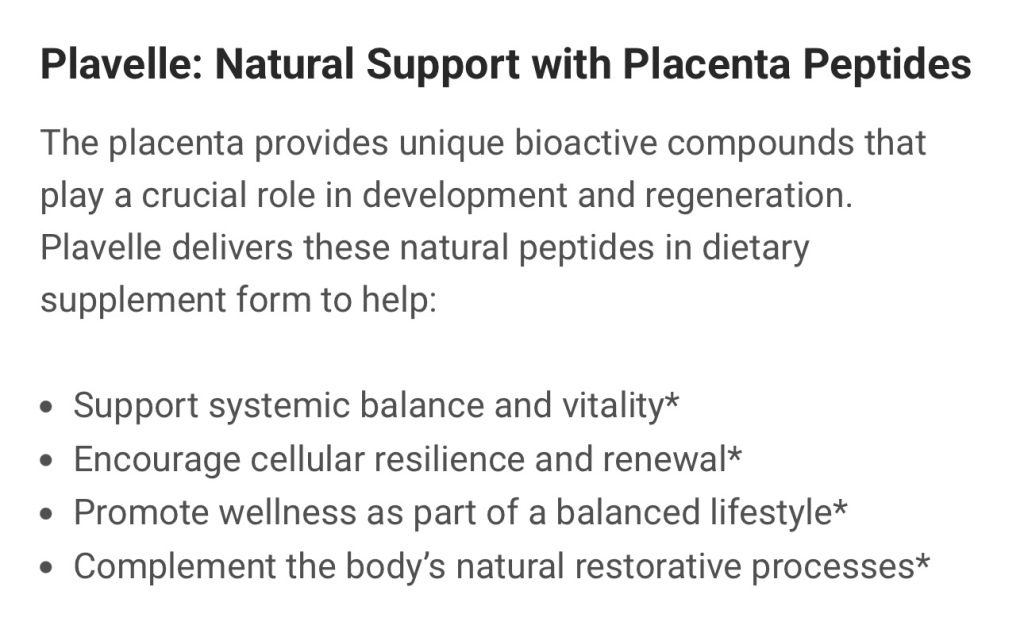
Not much is more exciting in the peptide world than unboxing and trying a brand new to market peptide!
We just got Plavelle, the placenta peptide – right in time for cold / flu season – and so far are loving it!
So let’s unpack what it can do & who it might help most.

What it is
- First up: the placenta peptide isn’t targeting a placenta in you, it’s for everyone.
- It’s a natural mix of ultra‑short peptides derived from placenta that act as gentle modulators.
It instructs body-wide:
• Immune balance
• Stress responses / Oxidative signaling
• Mild antimicrobial control
• Repair / recovery
so sensitive systems feel steadier without stimulation.
Short instruction notes that help the body self‑correct.
The concept comes from decades of organ specific peptide work aimed at restoring balance, repair, and healthy gene signaling.
How it works
- Smarter immunity. It tunes responses so you get efficient defense and clean resolution, not endless stimulation.
- Gentle Antimicrobial / Antiviral Certain placenta‑derived peptides can disrupt microbes and support antiviral signaling, helping reduce pathogen load without overreaction.
- Inflammation and oxidative stress reducer. It lowers excess inflammatory signals and oxidative stress, which protects cells and sets the stage for repair.
- Tissue healing and recovery. It supports new cell growth, improves microcirculation, and rebuilds tissue scaffolding—why skin and wound shifts are often noticed first.
See “Deeper Dive” at end of this page for more on specifics.
Why placenta?
In pregnancy, the placenta coordinates nourishment, protection, growth, immune tolerance, and circulation.
Peptides from placental tissue echo those messages. It’s excellent for anti-aging support or any challenged systems.
Historically, this category has been used for regeneration, immune balance, skin quality, and liver support.
What people can use it for
- Immune responses – more efficient & gentle with fewer flares.
- Antiviral support and recovery after illness, stress or workouts.
- Anti-inflammatory Effects – body wide
- Skin rejuvenation, elasticity, and calmer scar behavior.
- Gentle liver/metabolic support.
- Anti-aging: prevent cell death and enable repair
Who can benefit most
Sensitive people wanting non‑stimulating, gentle terrain support, or who react to stimulating immune tools.
Anyone looking for an easy entry point to peptide use.
Veteran peptide users who want a gentle regulator to help their gains stick between phases.
What it isn’t
This one isn’t a “quick fix.” Think of it as a steady guide toward balance and repair.

What the research suggests
Most published work points to:
- Immune modulation with antibacterial and antiviral activity.
- Wound healing, angiogenesis, and improved microcirculation.
- Lower inflammatory signals and oxidative stress.
- Skin repair and pigmentation balance; support for liver protection.
- Aging support via shifting gene activity toward repair.
Compared to other favorites
If TB4‑Frag is the repair contractor for deeper tissue remodeling, placenta is the site coordinator that calms the terrain, improves delivery, and supports clean immune resolution.
It’s broader and gentler, yet still a noticeable partner.
Placenta bioregulator vs. KPV
What KPV does best
- Direct antimicrobial action against bacteria, yeast / fungi (herx can result)
- Breaks down biofilms that shield microbes
- Often gives fast relief for MCAS, rashes, gut dysbiosis, and infection‑heavy states.
What Placenta does best
- Gently modulates immunity for efficient defense and calm resolution, has antiviral properties.
- Supports tissue repair, microcirculation, and scar/skin behavior.
- Lowers inflammatory noise and oxidative stress for a steadier overall feel.
- Antimicrobial tone is gentle – likely no herx.
For some MCAS relief (without KPV die off )
- NAD+: Steadies mitochondria so mast cells are calmer & less triggered. Our post here.
- Placenta: indirect help via immune balance and lower oxidative stress
A few Practical to ways to use Plavelle
- Viruses & Recovery: add it for immune‑calm and repair signaling for a full recovery arc (not just a narrow Th1 immune boost)
- Skin and scars: Plavelle plus Collacell (skin elasticity) for even deeper rebuild, more intensive anti-aging & microcirculation
- Sensitive terrain: start with Plavelle to build tolerance; layer other tools as you stabilize
My take
We’re excited to use this one and my daughter appeared to be coming down with a mild cold the same day it arrived. She took four, 1/4 cap doses.
By the next morning, she was not sick anymore. But I also followed our acute illness protocol.
I’m interested to see if it can help prevent illness this upcoming winter season.
Some of it’s antimicrobial action is evidenced by less scalp bacteria (longer between hair washings) and calmer GI.
I’ve read a lot about it helping with aging skin and paired with Collacell (skin elasticity bioregulator) I feel optimistic that soon I’ll look 10 years younger! But I’ll take 5 😌
Overall, this placenta bioregulator is a gentle, whole‑terrain helper.
I’d reach for it for sensitive or easily inflamed systems, and for inside‑out recovery, especially skin and liver support.
•••
I think of it like a body-wide hug to prevent and soothe life’s ailments.
We keep KPV for primary mast cell calming, antifungal coverage, stronger antibacterial effects and biofilms, and use TB4‑Frag when deeper tissue remodeling is the goal.
Thymogen is the Th1 immune stimulator, many people save for brief acute episodes only.
NAD+ stays the anchor for energy so everything works better and additional mast cell support.
For us, Plavelle should be an excellent everyday wellness peptide for broad ongoing support.
Our Dosing
I plan to use Plavelle just like many other Bioregulators:
Try 1/8 – 1/4 cap first to make sure you do well with it.
• 1/4 cap up to 2-3x per day (1 month)
• Decrease to 1/4 cap 1-2x per day and observe.
• Gradually taper and the pause until it seems needed again.
It’s not tasteless, putting in another capsule or bite of food works well.
Consider even less for smaller people.
•••
The more standard dosing is 2 caps, 1-2x per day for 30 days.
Why our dosing differs
Because of the way peptides signal:
• For a short duration (2-3 hours, until longer lasting genetic changes are remembered)
• And because they are often effective at extremely small doses
I find that more frequent, smaller doses are just as effective as larger daily ones.
Each person should experiment to find their best dosing.
Where to Buy
The well trusted Vita Stream manufactures and sells this – made in the USA – 3rd party tested peptide:
Plavelle Bioregulator at Vita Stream
Coupon Code: BIOREG10
- 10% off, Free Shipping in USA
(International Shipping also available)
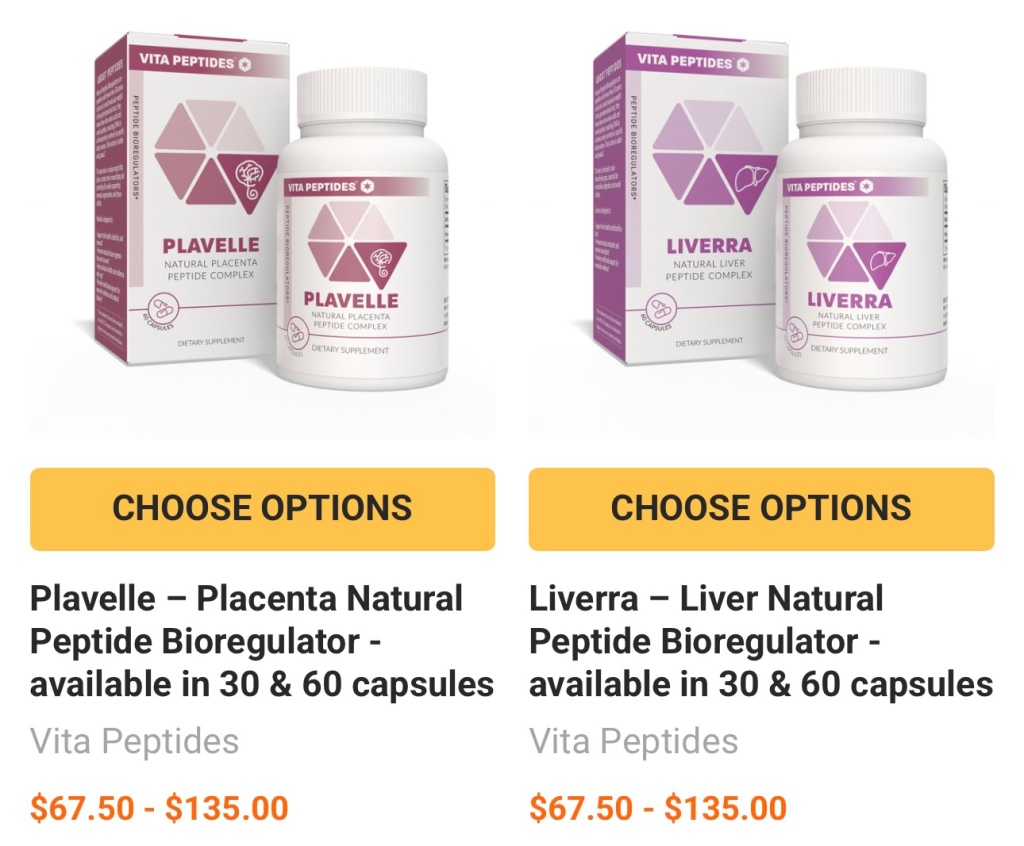
Also new: Liverra the liver bioregulator
New!
Plavelle is also featured in our latest post:
‘Virus Effect’ Hack: Remission for Autoimmune, PANS & Autism symptoms – every day
For custom help deciding which peptides, or supplements, or diets, or anything may be best for you:

Dive Deeper into Placenta Peptides
Immune Effects: Modulation Over Boosting
From the science, these peptides (like those derived from placental tissue in bioregulator formulas) act primarily as modulators – they adjust immune responses to be more efficient without overstimulating the system, which could lead to inflammation or autoimmunity.
This is especially evident in how they handle infections and stress.
•••
Here’s what stands out:
• Antibacterial and Antiviral Defense: They can tackle pathogens, reducing bacterial or viral loads to protect against infections.
For example, a specific placenta-derived peptide fragment (like HBB(112–147) from β-hemoglobin) shows broad-spectrum antibacterial action against Gram-positive and -negative bacteria, plus antiviral effects against things like HSV-2.
This isn’t just killing germs; it modulates by limiting pathogen spread, which indirectly calms the immune overreaction.
• Anti-Inflammatory and Response Regulation:
Rather than cranking up immunity indiscriminately, they dampen excessive inflammation (e.g., by inhibiting TNF-α production) while enhancing targeted responses.
This helps in chronic fatigue or stress scenarios by protecting cells from oxidative damage and maintaining balance.
They also increase levels of cytokines like IL-6, which supports immune cell communication and resolution of inflammation.
• Recruitment and Activation of Immune Cells:
Peptides like β-defensins and cathelicidins (expressed highly in placental tissue) recruit myeloid cells and lymphocytes to infection sites, while modulating Toll-like receptor (TLR) signaling to produce specific cytokines and chemokines.
This creates a tailored response – boosting when needed (e.g., against intracellular bacteria) but modulating to avoid harm.
Overall, it’s about smarter immunity: stimulating innate responses (like antimicrobial action) and adaptive ones (via interferons like IFN-α/β for antiviral control), but with a focus on resolution rather than amplification.
The “how” ties into their structure – short cationic peptides that bind to pathogens (forming pores or disrupting membranes) and interact with host cells to regulate gene expression for immune proteins.
They’re released via proteases in the placenta, reaching high concentrations for local and systemic effects.
In Russian bioregulator context (like Khavinson’s work), this modulation extends to geroprotection, helping immunity age better by normalizing protein synthesis.
Repair and Regeneration Mechanisms: Healing with Built-In Protection
These peptides go beyond mere protection, they actively drive healing by kickstarting cellular repair processes, while their protective side (like anti-inflammatory effects) creates a safer environment for that to happen.
It’s a combo of direct regeneration and damage prevention.
• Tissue Repair and Wound Healing: They promote actual healing by stimulating cell migration, proliferation, and new blood vessel formation (angiogenesis).
For instance, placenta-derived peptides enhance fibroblast activity, which builds new tissue and closes wounds.
This is seen in skin regeneration, where they normalize pigmentation and boost cellular respiration for faster recovery.
• Cellular and Mitochondrial Protection Leading to Repair:
By inhibiting reactive oxygen species (ROS) and maintaining mitochondrial networks, they prevent cell death and enable repair – think fixing damaged cells rather than just shielding them.
This ties into anti-aging benefits, reducing age-related decline by regenerating at a molecular level.
• Scaffold and Signaling Support: As bioregulators, they provide an extracellular matrix (ECM)-like scaffold for tissue rebuilding, while activating pathways like ERK1/2 for growth and repair signals.
Growth factors and cytokines in placental extracts further amp this up, making it true regeneration (e.g., in chronic wounds or diabetic healing).
•••
The mechanisms here involve regulating gene expression and protein synthesis to mimic the placenta’s natural role in nourishment and protection – peptides interact with cells to upregulate repair genes, while their antimicrobial side protects the healing site from infections that could derail progress.
In essence, it’s proactive healing with a protective layer baked in.
Reader Questions:
Q: Could you tell me more about how Plavelle acts on the immune system so I can feel safe it won’t be too stimulating?
- Sure! It’s context‑dependent, not pushy. Placenta peptides can recruit and activate immune cells, but the effect is shaped by what’s actually happening in the body.
- Local first, tailored second. β‑defensins and cathelicidins are cationic, so they can bind microbes directly and also signal host cells.
- That recruitment is targeted cleanup at the site, not a blanket immune ramp‑up. Efficient response with faster resolution, not a sustained cytokine climb.
- TLR modulation, not just activation. They can touch Toll‑like receptor pathways.
- With a true microbial signal, you get the right chemokines and cytokines to clear it.
- Without a strong pathogen signal, they read as immune‑balancing, lowering background inflammatory noise and oxidative stress.
- Innate plus antiviral readiness, with a brake. They can enhance innate antimicrobial actions and support interferon signaling for antiviral control, while carrying resolution cues.
- It’s in the non‑stimulatory bucket: steadier microcirculation, less after‑burn, calmer tissues.
- Why sensitive folks usually do fine. Short placenta peptides act like low‑volume coordinators and improve delivery and repair.
- As inflammation and ROS drop, mast cells and microglia calm, which counterbalances any narrow recruitment signal that might otherwise feel activating.
- Where I’d be cautious. If someone is extremely Th1‑dominant and flares with any immune shift, start small and watch.
- If true activation is needed during an acute virus, that’s where I use thymus tools briefly; Plavelle stays a terrain calmer, not a booster.
- Overall: Plavelle can recruit the right cells when needed, but its dominant effect is modulation and clean resolution rather than global stimulation. That’s why it’s used for sensitive systems.
Q: Could there be Viral “Die off” effects? I know viruses aren’t alive so it’s not a true die off..
A: It’s possible but uncommon.
Plavelle’s antimicrobial tone leans antibacterial/antiviral and it’s context‑dependent, so most people feel terrain calm rather than a herx.
If there’s a real viral burden, a brief “clear and resolve” window can look like extra fatigue, mild achiness, head pressure, or a short fever day, then it settles as resolution cues kick in.
If someone is prone to be very reactive, I do three things:
- Start smaller and split doses.
- Pair with NAD+ to steady energy and calm cytokines.
- If gut is leaky or you’re running other antimicrobials, use Larazotide before meals and a simple binder window away from food to keep debris moving.
If symptoms spike beyond mild and brief, pause Plavelle for a day or two, keep hydration and binder support, then restart lower.
If you’re in an actual acute virus and need more “push,” that’s where a short Thymogen window fits, while Plavelle stays the terrain calmer.
All peptide content, including Bioregulator Review is here:
Discover more from Diary of Recovery
Subscribe to get the latest posts sent to your email.

